Fall asleep faster. Wake up clearer. Stop wasting your days on poor sleep.
Poor sleep does not only ruin your nights.
It affects your energy, your mood, your focus, your digestion, your motivation and the way you experience the next day.
Science of Better Sleep is a short, practical guide designed to help you understand what may be disturbing your sleep — and what you can change, step by step, to sleep better naturally.
No complicated jargon.
No endless theory.
No miracle promise.
Just clear, science-backed advice to help you improve your nights and recover better.
A practical guide for better sleep
Have you ever wondered why you sometimes wake up exhausted, even after a long night?
Or why you can feel tired all evening, then suddenly alert the moment you get into bed?
Sleep depends on many interacting factors: daily rhythm, light, stress, nutrition, environment, breathing, physical activity, digestion and recovery.
This guide helps you connect the dots and identify the habits that matter most.
What this book helps you improve
Inside the guide, you will find practical strategies to help you:
- fall asleep more easily;
- wake up feeling more refreshed;
- reduce nighttime agitation;
- better understand your sleep cycles;
- improve your evening routine;
- support natural relaxation;
- adapt your bedroom environment;
- choose sleep habits that fit your body.
The goal is to help you build a more restorative relationship with sleep, one realistic change at a time.
Backed by science, written for real life
Science of Better Sleep is supported by scientific references, but written in a simple and accessible style.
The guide translates research into concrete habits you can actually use, without needing to read dozens of studies or follow an unrealistic protocol.
It gives you a practical framework to understand your sleep and make better decisions.
For whom?
This guide is for you if:
- you struggle to fall asleep;
- you wake up during the night;
- you often feel tired in the morning;
- your sleep feels irregular or fragile;
- stress affects your nights;
- you want natural strategies before considering stronger interventions;
- you prefer concise, practical, science-based advice.
A short guide that gets straight to the point
This is not a 300-page book about sleep science.
It is a concise guide designed to give you the essentials quickly, so you can stop searching randomly and start improving your habits.
Sleep better.
Recover better.
Wake up with more clarity.
A concise guide, backed by science
Science of Better Sleep is supported by dozens of scientific references and goes straight to the point in about 40 pages.
It was written for people who want practical, natural and evidence-informed strategies without synthetic medication and without wasting time.
You will not find miracle promises here.
You will find a structured toolbox to help you improve your sleep habits progressively, one step at a time.
Who is this guide for?
This guide is especially useful if you:
- have trouble falling asleep;
- wake up tired;
- experience nighttime awakenings;
- feel mentally agitated at night;
- want to improve your morning energy;
- want to understand sleep cycles;
- are looking for natural strategies to support sleep quality;
- want concise, practical and science-based advice.
It may also be helpful if you are interested in the relationship between sleep, digestion, stress, nutrition and the autonomic nervous system.
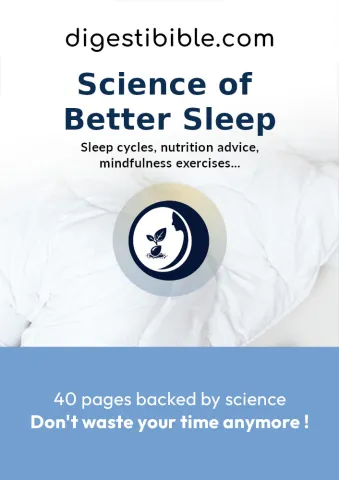
Sleep cycles, nutrition advice, mindfulness exercises…
40 pages backed by science
Science of Better Sleep
Sleep cycles, nutrition advice, mindfulness exercises… 40 pages backed by science.
Important medical disclaimer
This guide is provided for informational and educational purposes only.
It does not replace medical advice, diagnosis or treatment from a qualified healthcare professional.
If you suffer from chronic insomnia, severe fatigue, suspected sleep apnea, depression, anxiety, breathing problems, neurological symptoms or any persistent health condition, consult a qualified healthcare professional.
Before starting any supplementation program or significantly changing your diet, seek medical advice, especially if you take medication, are pregnant, breastfeeding or have a pre-existing medical condition.